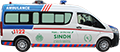
First aid and CPR training Sindh communities can rely on is delivered by SIEHS DRDE, the Department of Research, Development & Education of Sindh Integrated Emergency & Health Services (SIEHS), the province’s leading provider of emergency health services in Sindh. It exists because most emergencies are decided in the minutes before an ambulance arrives, not after.
The Free Emergency Ambulance Service in Sindh – SIEHS 1122 has handled over 28.8 million calls and responded to more than 128,000 road traffic accident cases across the province since August 2021, providing 24/7 emergency ambulance response and rapid pre-hospital medical care to residents who cannot always wait. A trained bystander in those first minutes — checking breathing, controlling bleeding, or starting CPR — can be the difference between life and death. That is the gap first aid and CPR training Sindh through DRDE is built to close.
Emergencies in Sindh rarely wait for a hospital or ambulance to arrive first. Heart attack symptoms, stroke symptoms, severe road accidents, trauma injuries, respiratory distress, and sudden loss of consciousness can all happen without warning, at home or on a busy street. Bystanders usually want to help but do not know the safe first steps — and untrained action, like moving an injured person too quickly or giving water to someone unconscious, can make an injury worse.
This is the exact problem DRDE’s community training addresses: turning bystanders into confident, safe first responders during the window before professional help arrives.
DRDE’s scope of work includes structured Basic Life Support and Basic First Aid training, delivered by the same team of medical professionals, paramedics, and emergency medical technicians who staff SIEHS’s ambulances and their advanced life-support systems. The organisation has already trained over 6,600 emergency responders through 350+ training sessions since 2021, including corporate programmes for organisations such as Shell Pakistan and PARCO.
CPR is needed when a person is experiencing severe breathing difficulty, is not breathing normally, or their heart has stopped — situations where every minute reduces the chance of survival. According to the American Heart Association, starting CPR immediately, before professional help arrives, meaningfully improves a person’s chance of survival compared with waiting. Training covers recognising when CPR is needed and responding without freezing.
Severe bleeding can become life-threatening within minutes. Training covers applying firm, direct pressure safely and avoiding methods that can worsen an injury — relevant for road crashes, workplace accidents, and household injuries.
Choking can happen at home, school, work, or in public. Training covers recognising choking signs early and responding correctly, since incorrect action can increase risk rather than reduce it.
Moving an injured person too quickly, especially after a fall, crash, or suspected spine injury, can cause further harm. Training covers when to keep a patient still and how to protect them until paramedics arrive.
SIEHS operates in 30 districts across the province — including ambulance service Karachi, emergency ambulance Hyderabad, and coverage in Sukkur, Larkana, Mirpurkhas, Tharparkar, Nawabshah, and Dadu — as part of its free ambulance Sindh network. Community and corporate groups anywhere in this network can request training sessions — reach out using the contact details below to check availability in your district.
To arrange first aid and CPR training Sindh-wide for your family, school, workplace, or volunteer group, contact SIEHS directly:
First aid and CPR training in Sindh, delivered through SIEHS DRDE, turns residents into a community’s first line of defence, not replacing paramedics but bridging the minutes before they arrive. With over 6,600 responders already trained and a presence across 30 districts, SIEHS DRDE is extending that readiness beyond its own staff and into homes, schools, and workplaces across the province.
This training sits alongside SIEHS’s other community healthcare programs across Sindh: rapid emergency response and patient transport through the SIEHS 1122 Emergency Ambulance Service, and round-the-clock medical advice through the Tele Tabeeb 1123 Telemedicine Service, a 24-hour telemedicine platform staffed by PMDC-certified doctors.
To bring first aid and CPR training to your family, school, or organisation, call 021-111-111-823 or email info@siehs.org.
Who delivers SIEHS DRDE’s first aid and CPR training in Sindh?
Training is delivered by SIEHS RDE’s in-house team of medical professionals and paramedics, the same department responsible for training SIEHS’s own emergency medical technicians.
What does the training cover?
Core modules include Basic Life Support and CPR awareness, bleeding control, choking response, and safe patient handling before professional help arrives.
Which areas of Sindh does SIEHS DRDE training cover?
SIEHS operates across 30 districts in Sindh, including Karachi, Hyderabad, Sukkur, Larkana, Mirpurkhas, and Tharparkar.
What should I do in an emergency while waiting for training or an ambulance?
Call 1122 immediately, avoid crowding the patient, do not give food or water to someone unconscious or fainting, and avoid moving them unless there is immediate danger.
What is the emergency ambulance number in Sindh, and is it free?
1122 is the ambulance number in Sindh for SIEHS’s free emergency ambulance services, available around the clock. For non-emergency medical questions, Tele-Tabeeb 1123 connects callers with a doctor by phone for a preliminary diagnosis, 24 hours a day.
WhatsApp us