Most emergencies do not happen inside hospitals. They happen at home, on roads, in schools, at offices, and in public spaces where people usually have two things in common: concern and no idea what to do first.
That is the gap.
There is still a habit of treating life-saving response as something that begins when professionals arrive. But by the time an ambulance reaches the scene, the emergency has already started. The first few minutes usually belong to whoever is nearby.
And that person is rarely a doctor.
When someone starts choking, there is no benefit in standing still and looking serious. When a person collapses in cardiac arrest, panic does not count as assistance. Emergencies are not improved by crowds, volume, or confident misinformation.
They are improved by action.
That does not mean everyone needs to become a clinician. It means more people should know what to do until trained help arrives. In many cases, that window matters more than people realise.
A person in cardiac arrest needs CPR. Someone choking needs immediate response. In both cases, the difference between presence and preparedness becomes obvious very quickly.
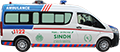
You get expert help by calling 1122 ambulance in Sindh, but before that, what do you do?
This is exactly why life-saving training needs to move beyond clinical walls.
At SIEHS, Basic Life Support and first aid trainings are conducted internally and externally through hands-on sessions and practical demonstrations. These training sessions cover essential responses such as first aid, CPR, choking (adults & children) management, and live demonstrations of the Heimlich manoeuvre, along with basic emergency response skills that help people act quickly and correctly.
The point is not to make people experts. The point is to make them useful.
Most people do not freeze in emergencies out of indifference. They freeze because nobody ever taught them what a useful first response looks like.
Life-saving knowledge makes more sense in communities than people think.
This work has already reached well beyond clinical settings. By 2026, SIEHS Research, Development & Research department(RDE) reached 779 trainees in total. The number matters not just as a milestone, but as proof that emergency readiness can be taught at scale, outside hospitals, and closer to the public.
Teaching these skills means putting the response where it is most likely to be needed. It gives people a basic framework. It helps them recognise what is happening, respond without making things worse, and hold the situation until professional care takes over.
That is not a small thing. That is the start of a stronger emergency response culture.
Hospitals remain essential. Ambulance services in Sindh remain essential. Professional emergency care remains essential.
But life-saving knowledge should not begin and end there.
Before emergency care becomes clinical, it is often human. Someone nearby sees what happened. Someone nearby has to decide whether to step in. It is better if that person knows what they are doing.
If your school, workplace, or community space would like to host a Basic Life Support or first aid training session, SIEHS can help bring these skills closer to the people most likely to need them before emergency teams arrive.
WhatsApp us