In the high-stakes world of emergency medicine, there is a concept known as the ‘Golden Hour.’ It refers to the critical window of time following a traumatic injury or a sudden medical collapse during which prompt medical treatment has the highest likelihood of preventing death or permanent disability. Across the diverse landscape of Sindh—from the vertical density of Karachi’s skyscrapers to the sprawling, sun-baked plains of Tharparkar—the challenge has always been bridging the gap between the onset of an emergency and the arrival at a hospital bed.s
The Sindh Integrated Emergency & Health Services (SIEHS) was established to solve this exact problem. By launching the Free Emergency Ambulance Service in Sindh – SIEHS 1122, the provincial government created a sophisticated, tiered response system that ensures no citizen is more than a phone call away from life-saving intervention.
Historically, emergency transport in the region was often fragmented, relying on a mix of private providers, philanthropic organisations, and basic transport vans that lacked medical equipment. Sindh Integrated Emergency & Health Services (SIEHS) changed the paradigm by introducing a service that prioritises rapid pre-hospital medical care over simple transportation.
The philosophy is simple: the ambulance should be an extension of the hospital’s Emergency Room. This approach requires an immense investment in technology, human capital, and logistics. Today, SIEHS 1122 stands as a model for public-private partnerships, operating a fleet of hundreds of ambulances that are free of charge for every resident of the province.
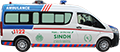
When you see a SIEHS 1122 vehicle navigating through traffic, you are looking at a mobile intensive care unit. These vehicles are categorized as Category-A (Advanced Life Support) ambulances, equipped with:
One of the most significant hurdles in providing emergency ambulance coverage across Sindh is the sheer geographical variety. A strategy that works in the grid-locked streets of Karachi will not necessarily work in the riverine areas of Larkana or the deserts of the south.
To manage this, SIEHS utilizes a state-of-the-art Command and Control Centre. This hub acts as the brain of the operation, using GPS tracking and GIS mapping to dispatch the nearest available unit. This ensures a 24/7 emergency ambulance response that is both data-driven and empathetic.
In major urban centres, the focus is on overcoming traffic congestion. An ambulance service in Karachi or an emergency ambulance in Hyderabad must navigate some of the most crowded roads in the world. SIEHS accomplishes this by placing ambulances at strategic “hotspots” rather than central depots, allowing them to reach the scene within minutes of a call.
In rural districts like Sukkur, Larkana, Mirpurkhas, Nawabshah, and Dadu, the challenge is distance. Here, the service acts as a vital link between remote villages and tertiary care hospitals. For residents of Tharparkar, where healthcare access has traditionally been limited, the presence of a free ambulance Sindh can provide has fundamentally shifted the mortality rates for treatable conditions.
Not every medical concern requires a high-speed ambulance. In fact, many emergencies can be mitigated or managed through expert advice. This is where the Tele Tabeeb 1123 Telemedicine Service plays a pivotal role.
As a 24-hour telemedicine platform, Tele Tabeeb allows citizens to dial 1123 and speak directly with qualified doctors. This service provides:
Public awareness is the fuel that runs this engine. To ensure the rapid emergency response remains efficient, it is vital for citizens to recognize when a situation warrants an ambulance.
If a person experiences sudden chest pain, radiating pain in the left arm, or cold sweats, they may be showing heart attack symptoms. Similarly, if a person is gasping for air or showing signs of cyanosis (bluish tint to lips/fingernails), they are in respiratory distress. These are high-priority calls for SIEHS 1122.
Stroke symptoms—often remembered by the acronym FAST (Face drooping, Arm weakness, Speech difficulty, Time to call 1122)—require immediate intervention to prevent brain damage. Any instance of sudden loss of consciousness or an unexplained seizure should also be treated as a major emergency.
Severe road accidents often involve multiple injuries. In these cases, moving a patient without professional help can cause permanent spinal damage. The EMTs on a SIEHS ambulance are trained in “extrication” and “immobilisation,” ensuring the patient is moved safely.
In many parts of the world, an ambulance ride can result in a debt that takes years to repay. In Sindh, the government’s commitment to making this a free emergency ambulance service is a massive social safety net. It ensures that the poorest residents in Larkana or Sukkur receive the same level of care and the same advanced life-support systems as a resident in a wealthy Karachi suburb.
This removal of the cost barrier encourages people to call for help sooner. When people don’t have to worry about the bill, they call at the first sign of breathing difficulty rather than waiting until it’s too late. This proactive healthcare seeking is what truly saves lives on a provincial scale.
The heroes of this story are the emergency medical technicians. The training they undergo is exhaustive. They are taught to manage severe bleeding, perform CPR, use automated external defibrillators (AEDs), and provide psychological first aid to distraught families.
SIEHS 1122 handles patient transport for such a wide variety of cases; these technicians are also trained in incident command. In the event of a mass casualty incident, such as a major fire or a structural collapse, the SIEHS teams are often the first to arrive, setting up triage stations to ensure the most critical patients are treated first.
SIEHS is not a static organisation. It is constantly evolving based on the needs of the community. This includes the deployment of specialised vehicles, such as the bike ambulance service for narrow urban alleys, and the continuous expansion of community healthcare programs across Sindh.
The goal for the coming years is to further reduce the average response time and to integrate artificial intelligence into the dispatch system to predict where emergencies are most likely to occur based on historical data.
The Ambulance number in Sindh (1122) is more than just a digit; it is a promise of professional, compassionate, and rapid care. Whether you are dealing with trauma injuries from a fall, the sudden onset of stroke symptoms, or a child in respiratory distress, the SIEHS 1122 network is standing by. By combining advanced life-support systems, a 24-hour telemedicine platform, and a dedicated team of professionals, Sindh is setting a new standard for emergency care in South Asia.
WhatsApp us