A child with a fever that won’t break, weight that won’t climb, and mouth sores that keep returning is often treated for “just another infection.” Sometimes it is. Sometimes it isn’t. Children in Sindh face a documented, elevated risk of HIV; not from lifestyle factors, but from unsafe medical practices that most parents never think to question. This guide explains why that risk exists, the HIV symptoms in children to watch for, and where families can turn for testing and free medical advice, including Tele-Tabeeb 1123, a 24-hour telemedicine platform.
Children can acquire HIV before birth, during delivery, or through breastfeeding if the mother has untreated HIV. But in Sindh, the bigger documented driver has been unsafe injections, contaminated blood, and reused syringes, routes the World Health Organization lists among key HIV risk factors.
The pattern connects directly to earlier outbreaks. In April–June 2019, an HIV outbreak centred on Ratodero, Larkana District, found 876 positive cases out of 30,192 people screened. Most of them were children, with 82% under the age of 15. The cluster was linked to unsafe healthcare practices, including unsafe injections, unsafe delivery procedures, weak blood bank practices, poor infection control, and improper hospital waste disposal. It remains one of the largest paediatric HIV outbreaks recorded in Pakistan, and it is a core reason community healthcare programmes across Sindh now push safe-injection awareness as hard as they do.
WHO and UNAIDS warned that children in Pakistan are increasingly affected by HIV, and that unsafe injections and blood transfusions have played a role in recent outbreaks across Sindh. This is why safe-injection awareness, proper testing, and early medical consultation are essential for protecting children.
Risk is highest in early childhood; symptoms are worth knowing by age:
None of these confirm HIV on their own. A pattern of repeated, unexplained illness in a child recently exposed to injections, transfusions, or unregistered clinics is what should prompt a test.
Beyond mother-to-child transmission, the clearest risk markers in Sindh are:
A child with any of these in their recent history, combined with the symptom pattern above, should be tested, not just monitored.
Symptoms can stay hidden for months, and some children look entirely well early on. HIV.gov is direct about this: the only way to know for certain is a test, not a symptom checklist.
For infants born to mothers with HIV, WHO recommends testing by two months of age, during breastfeeding, and again after breastfeeding ends. Testing should always be accompanied by consent, confidentiality, and a clear path to treatment if the result is positive.
Mother-to-child transmission is preventable. When a pregnant woman with HIV receives antiretroviral therapy (ART) throughout pregnancy and breastfeeding, the risk of passing HIV to her baby drops sharply. Early antenatal testing matters as much as testing the child after birth.
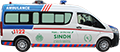
Before any injection, confirm the syringe is new and sealed. Choose registered healthcare providers. Avoid reused needles, shared blades, or unsterile dental tools. Rapid pre-hospital medical care also matters; for genuine medical emergencies, SIEHS 1122 provides free emergency ambulance service in Sindh with trained emergency medical technicians, reducing risk from unsafe emergency handling.
HIV does not spread through hugging, sharing food, or ordinary contact. If exposure is a concern, speak to a doctor and keep a record of recent injections, transfusions, or clinic visits to help with risk assessment. You can get free online doctor consultation on Tele-Tabeeb 1123.
Yes. ART is recommended for every person with HIV, including children, and with consistent treatment, children can live long, healthy lives. Parents often need support around medicine taste, timing, and stigma: this is normal, not a sign treatment isn’t working.
Sindh Integrated Emergency & Health Services (SIEHS) runs two relevant services. For genuine emergencies, SIEHS 1122 Emergency Ambulance Service offers 24/7 emergency ambulance response across districts including Karachi, Hyderabad, Sukkur, Larkana, Mirpurkhas, Tharparkar, Nawabshah, and Dadu. For non-emergency guidance, including whether a child’s symptoms warrant clinic testing, Tele-Tabeeb 1123 connects families to an online doctor free of charge, any time of day.
If your child has had injections, transfusions, or care at an unregistered clinic or shows repeated, unexplained illness, don’t wait for symptoms to become undeniable. Speak to a qualified doctor, ask directly about testing, and use Tele-Tabeeb 1123 if you need free guidance on the next step. Early diagnosis is what lets a child start treatment, stay in school, and grow up healthy.
Why are children in Sindh at high risk of HIV?Documented outbreaks, particularly the 2019 Ratodero cluster, have been linked mainly to unsafe injections and reused medical equipment rather than lifestyle factors.
What is the ambulance number in Sindh for a medical emergency?Dial 1122 for free emergency ambulance services anywhere SIEHS operates across Sindh.
Can HIV symptoms appear in babies before one year old?Yes, poor weight gain, recurrent diarrhoea, and delayed milestones are among the earliest signs in infants.
Is Tele-Tabeeb 1123 free to use?Yes, it’s a free 24-hour telemedicine service for non-emergency questions, including preliminary diagnosis before an in-person visit.
Can HIV be passed to a baby during pregnancy?Yes, but mother-to-child transmission is largely preventable when the mother receives ART during pregnancy and breastfeeding.
WhatsApp us