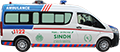
In the heart of Sindh, where vast, serpentine waterways meet the shimmering horizon, a new chapter of emergency health services in Sindh is being written. For centuries, the Indus River has been the lifeblood of the province, but for those living on its banks or venturing onto its lakes, it has also presented a formidable barrier to modern medicine. Historically, communities living along the riverine belts or near the province’s expansive lakes faced a daunting reality: in a water-based emergency, the seconds lost to geographical barriers often meant the difference between life and death.
To address this critical gap, Sindh Integrated Emergency & Health Services (SIEHS) has pioneered a solution that bridges the divide between land and water. With the deployment of the Riverine Boat Ambulance service, we have ensured that the reach of the free emergency ambulance service in Sindh – SIEHS 1122 is no longer limited by the shoreline.
While the inauguration at Keenjhar Lake on 4th December 2025 marked a significant milestone for the province, these vessels are far more than a local convenience. They are a vital, strategic component of our emergency ambulance coverage across Sindh. Designed to serve multiple districts where water transport is the only viable link—from the coastal riverine belts of Thatta and Sujawal to the northern stretches of the Indus River in Sukkur—these boats represent a literal lifeline for millions.
Developed specifically to navigate the unique and often unpredictable challenges of Sindh’s waterways, Riverine is essentially a mobile, floating clinic. It is not merely a transport craft designed for speed; it is a sophisticated medical unit engineered to provide the same high standard of rapid pre-hospital medical care that citizens have come to expect from our land-based “HOPE” ambulances.
When a patient is on the water, the environment is unstable, and access to a hospital is often miles away. Therefore, each boat is outfitted with advanced life-support systems, including:
This robust infrastructure ensures that life-saving interventions begin the moment a patient is pulled from the water. In the world of emergency medicine, the “Golden Hour” is the window in which prompt treatment is most likely to prevent death. By bringing the emergency room to the water, we are effectively shrinking that window.
The true value of this strategic deployment is best understood through the lives it has already touched. On the afternoon of 22nd March 2026, at Keenjhar Lake, the theory of rapid response became a life-saving reality. At 14:15, a 22-year-old Karachi resident named Adnan, who was visiting the lake with friends, accidentally slipped into a deep-water zone.
In previous years, such an incident might have ended in tragedy, as bystanders would have had to scramble for a local fishing boat or wait for land-based help to arrive. However, the SIEHS 1122 Emergency Ambulance Service was already on the water for a routine safety patrol—a proactive strategy we employ during peak visiting hours to ensure a rapid emergency response.
The crew—Emergency Medical Assistant (EMA) Asadullah and Boat Coxswain Jafar—spotted the distress immediately. Within minutes, they reached Adnan, who was struggling against the current. They pulled him aboard, where EMA Asadullah immediately identified signs of severe breathing difficulty and shock. While Jafar expertly navigated the vessel back to the shore, Asadullah administered critical oxygen support and monitored Adnan’s vitals to ensure he did not slip into a further loss of consciousness.
The rescue of Adnan did not end at the pier. As the boat sped toward the shoreline, our integrated command and control system was already synchronising the next phase of the rescue. This is the hallmark of Sindh Integrated Emergency & Health Services (SIEHS): a seamless, interconnected web of care.
A land-based emergency ambulance Hyderabad unit was alerted and waiting at the docking point. As the boat touched the shore, EMT Fayyaz and Emergency Vehicle Operator (EVO) Shoaib Ali took over, ensuring the transition was smooth and that Adnan’s stabilised condition was maintained. He was then safely transported to DHQ Makli for further observation.
This level of coordination ensures that patient transport is never a “blind” hand-off. The medical data gathered on the boat is shared with the land crew and the hospital, ensuring that when the patient arrives at the ward, the doctors are already prepared for the specific trauma injuries or conditions they are about to treat.
The Riverine Boat Ambulance is a symbol of our broader commitment to provide community healthcare programmes across Sindh. We recognise that Sindh is a land of diverse topographies, and our service must be equally diverse. Whether you require an ambulance service Karachi in a congested urban centre or a boat in the marshes of Sujawal, SIEHS is there.
While our physical fleet handles the front lines, we are also revolutionising how medical advice is sought through the Tele Tabeeb 1123 Telemedicine Service. This 24-hour telemedicine platform serves as a vital first point of contact for many citizens.
Not every health concern requires a high-speed ambulance, but every concern deserves professional attention. By dialling 1123, citizens gain access to PMDC-certified doctors who can provide a preliminary diagnosis and guide them through critical moments. This service is especially vital for:
What is the primary emergency ambulance number in Sindh?For any immediate, life-threatening situation on land or water, you should dial 1122. This connects you to theSIEHS 1122 Emergency Ambulance Service command centre for rapid emergency response.
Is the SIEHS 1122 service really free?Yes. The Free Emergency Ambulance Service in Sindh is a government-funded initiative. There are no charges for the boat ambulance, the land ambulance, or the medical supplies used during your treatment.
Can the boat ambulance handle night-time rescues?Absolutely. Our boats are equipped with high-intensity searchlights and navigational sonar, allowing for a full 24/7 emergency ambulance response even in poor visibility or late at night.
What should I do if someone stops breathing or loses consciousness near the water?Call 1122 immediately. If you are near a SIEHS boat station, alert the crew. While waiting, you can call Tele Tabeeb 1123 for over-the-phone guidance on performing basic life-saving measures.
How does SIEHS ensure quality in remote areas like Tharparkar or Dadu?We maintain a uniform standard of care. Every ambulance, whether in a city or a remote district, is equipped with advanced life-support systems and manned by certified Emergency Medical Technicians (EMTs).
Does SIEHS 1122 only respond to road accidents?No. While we are experts in handling severe road accidents, our teams are trained for all medical emergencies, including cardiac events, obstetric emergencies (childbirth), fire injuries, and water-related rescues.
How is the Boat Ambulance different from a standard boat?A standard boat is for transport; a Boat Ambulance is a medical facility. It contains specialised flooring for medical procedures, oxygen cylinders, suction machines, and monitors specifically designed to function in a maritime environment.
What information should I provide when calling 1122?Stay calm and provide your exact location (or a nearby landmark), the nature of the emergency (e.g., breathing difficulty, trauma injuries, or loss of consciousness), and a contact number so the crew can reach you.
The introduction of the Riverine Boat Ambulance is not the end of our journey, but a bold step forward. At Sindh Integrated Emergency & Health Services, our mission is to ensure that the “Golden Hour” is accessible to every human being in the province, regardless of their socio-economic status or their location on the map.
We are constantly evaluating our data to identify “black spots” where response times can be improved. This data-driven approach allows us to station our units—whether they be bikes, boats, or vans—exactly where they are needed most. From the bustling streets of Karachi to the quiet banks of the Indus in Sukkur, our presence is a promise that help is never far away.
As we continue to expand our Emergency Ambulance Coverage across Sindh, we invite the community to be our partners. Learn the signs of a stroke, understand basic first aid, and always remember that in your moment of crisis, SIEHS 1122 is your dedicated lifeline.
For more information on our fleet, our mission, or our community healthcare programmes across Sindh, please visit our official website at www.siehs.org.
WhatsApp us