TIn real life, it’s a timer that starts the second something goes wrong—a crash, a fall, a cardiac event, a sudden complication at home. Those first 60 minutes often shape the outcome.
People picture the life-saving moment as an ambulance pulling up with sirens and urgency. That’s only the visible part. The truth is less cinematic (and more useful): systems win the golden hour long before the emergency happens.
Zakat isn’t just “being generous.” It’s one of the few parts of life designed to be structural—a built-in mechanism that moves wealth from comfort to need on purpose, every year. Not because it’s trendy, but because people shouldn’t have to earn the right to survive bad luck.
And people often forget this: zakat doesn’t only serve the final recipient. It reduces friction in society. It ensures the vulnerable don’t wait for someone’s mood, schedule, or “I’ll do it later.” Zakat isn’t random kindness. It’s planned responsibility.
That makes it uniquely compatible with emergency care. In emergencies, the problem is rarely that no one cares. The problem is that care arrives late.
In emergency care, zakat doesn’t simply “support” services—it maintains the system. It keeps the chain intact so the golden hour doesn’t turn into “we tried.”
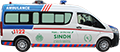
Sindh Integrated Emergency & Health Services (SIEHS) operates a 627+ fleet across Sindh, navigating terrain that never comes in one neat shape. But a fleet alone doesn’t guarantee availability. Every emergency system depends on its least glamorous parts, because emergencies never wait for procurement.
So what does zakat actually do at a systems level?
No one donates thinking, “I hope this funds a new battery.” But batteries matter when someone’s breathing depends on a machine working exactly as it should.
EMS literature commonly cites a benchmark of roughly one ambulance per 50,000 people, with some sources placing the range between 40,000 and 50,000 depending on context.
Now compare that to daily reality in Sindh. Even with 627+ response units, demand never slows—and the system absorbs it.
Across Sindh, SIEHS handles 24,000+ calls every day. Since launch, teams have carried out 6.4 million interventions, responded to 120,000+ road traffic accidents, and delivered 920+ babies inside ambulances.
When you give zakat to SIEHS, you don’t just help one person. You strengthen the system. You fund readiness—the buffer that keeps response times steady during normal wear and tear and during abnormal spikes: accidents, floods, disasters, heatwaves.
During the golden hour, the difference rarely comes down to whether people cared. It comes down to whether the system stood ready.
And “almost ready” offers little comfort in an emergency.
One decision on your end can shorten the wait for someone else. Give your zakat to SIEHS and help keep emergency care dependable across Sindh.
FAYSAL BANKTitle: Sindh Integrated Emergency and Health ServicesAccount: 3574-4360-0000-3043IBAN: PK45FAYS3574436000003043
SINDH BANK LIMITEDTitle: Sindh Integrated Emergency & Health ServicesAccount: 5301-604070-1000IBAN: PK09SIND0053016040701000
WhatsApp us