Trauma doesn’t send a calendar invite. It doesn’t wait for the “right time.” It arrives suddenly—on a road, in a factory, or at home—usually when everyone’s brain is stuck on one thought: “ab kya?”
That moment is the point. Trauma isn’t only about the injury itself. It’s about what happens in the minutes right after.
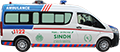
At Sindh Integrated Emergency & Health Services (SIEHS), we meet people in that exact window—before the hospital lights, before the paperwork, before anyone has fully understood what just happened. That’s where outcomes begin to take shape. Not by luck, but by immediate care.
Some injuries are obvious: blood, crashes, loss of consciousness. Others are quieter.
A person may be talking, walking, and saying they’re fine—while their body is already slipping into shock.
That’s what makes trauma dangerous. It can change quickly, and the first few minutes matter more than most people realize. Immediate care isn’t about doing everything. It’s about doing the right thing early, before the situation becomes irreversible.
In a crisis, people don’t freeze because they don’t care. They freeze because they’re trying to make sense of what they’re seeing.
The goal in those first moments is simple: don’t let the situation get worse.
If breathing is affected, that becomes the priority. Heavy bleeding needs to be controlled immediately. After a fall or crash, moving someone without thinking can turn a serious injury into a permanent one.
This is also where well-meaning chaos shows up. Ten people shouting instructions isn’t a response plan—it’s just noise with confidence.
Not every emergency happens near a hospital. Not every family knows what to do while help is on the way.
That’s where Tele-Tabeeb makes a difference.
In high-stress moments, people don’t only need reassurance—they need clear instructions. What to do now. What not to do. When to escalate. When a symptom is a red flag instead of something to “wait and see.”
Sometimes, one calm instruction at the right time prevents a mistake that could cost hours—or a life.
Here’s the uncomfortable truth: most emergencies don’t happen in front of doctors. They happen in front of coworkers, classmates, and families—people who care, but don’t know what to do.
That’s why Basic Life Support (BLS) training matters.
SIEHS teams deliver BLS sessions in varied settings—from nursing students in Sanghar to industrial sites like Rafhan in Kotri, Jamshoro. In industrial environments, training also includes basic firefighting response, because emergencies don’t arrive in neat categories.
When 250 people attend a BLS session at a place like Engro, it’s more than a number. It means more people who won’t freeze. More people who can respond with skill instead of panic.
This isn’t about turning everyone into a medic. It’s about making sure the first few minutes aren’t wasted.
Hospitals matter. Expertise matters. Equipment matters.
But trauma outcomes are often shaped before a patient reaches the hospital—by the first decision, the first action, and the choice to stay calm instead of panicking.
Immediate care isn’t a dramatic speech. It’s basics done correctly, quickly, and calmly.
Waiting for a situation to “look serious enough” is often how it becomes serious.
If your gut is telling you, “yeh normal nahi hai,” listen to it. Don’t wait for certainty.
Trauma doesn’t always announce itself loudly. Sometimes it gets worse quietly.
Keep it simple:
And remember: the right call matters as much as the right care.📞 Dial 1122 for emergencies📞 Call 1123 for non-emergency guidance and support
Because in those first few minutes, time is already moving—you shouldn’t be stuck guessing.
WhatsApp us