An emergency in Sindh meant pure panic. If someone collapsed with heart attack symptoms or was hurt in a severe road accident, it was usually a khuda-bharose (left to God) situation. In those critical moments where every second felt like an hour, families were left to their own devices. You’d call a relative with a car, hope a passing rickshaw would stop, or call a private ambulance that charged fees many simply could not afford. The “Golden Hour”—that crucial window where medical intervention can prevent death—was often lost to traffic, logistics, and a lack of professional help.
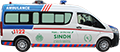
But today, the landscape of the province has shifted. When you see that white and blue van zipping through Karachi traffic or parked along a highway in the interior, you’re looking at the Free Emergency Ambulance Service in Sindh – SIEHS 1122. This is not just a government initiative; it is a genuinely world-class Sindh Integrated Emergency & Health Services (SIEHS) system that has redefined what it means to care for a citizen in distress.
We used to think an ambulance was just a fast way to get to the hospital ward—a “taxi with a siren.” SIEHS has completely flipped that outdated narrative. They have shifted the focus from mere transportation to rapid pre-hospital medical care.
The SIEHS 1122 Emergency Ambulance Service functions as a mobile emergency room. Each vehicle is equipped with advanced life-support systems, featuring 29 different pieces of life-saving equipment. From defibrillators and ventilators to specialized cardiac monitors, these vans are prepared for the most dire circumstances.
Crucially, the heart of this service lies in its people. The Emergency Medical Technicians (EMTs) don’t just drive; they are the first line of defence. They are trained to fight for the patient’s life the moment they arrive on the scene. Whether it is managing severe bleeding, providing oxygen for breathing difficulty, or stabilizing a patient with trauma injuries, the medical intervention begins in the driveway or on the roadside—not minutes later at the hospital. This shift in strategy has significantly improved survival rates across the province, providing a safety net for those facing respiratory distress or a sudden loss of consciousness.
Sindh’s geography is as diverse as its people, and it presents unique challenges that a standard ambulance cannot always solve. You have the tight, suffocating lanes of Liaquatabad and old Karachi where a wide van simply cannot enter. Then you have the vast, sandy stretches of Tharparkar and the rugged terrains of the north.
To tackle this, SIEHS introduced the Rapid Response Bike, which has been a masterstroke for urban density. These bikes can weave through heavy traffic and narrow alleys, reaching the patient minutes before a larger vehicle can.
Even more revolutionary is the Rapid Response Bike Female EMT Squad. In our society, parda and cultural comfort are significant factors in healthcare. Having brave, professional female paramedics arrive on bikes to help women in distress is a landmark achievement for Sindh. It breaks social barriers while ensuring that female patients receive immediate, dignified care.
The innovation does not stop at city limits. For areas where even motorbikes struggle, SIEHS deployed Mountain Bicycle Ambulances—a first-ever move in the region to ensure that no “goth” (village) is left behind. Furthermore, recognizing that Sindh is a land of rivers and coastal belts, the Riverine boat ambulance recently joined the fleet. Whether the emergency is on land or water, SIEHS has ensured that the distance between a patient and a doctor is shorter than ever before.
One of the biggest hurdles in an emergency is communication. Panicked callers often struggle to explain their exact location. With the Hope 24/7 application, help is literally at your fingertips. The app uses GPS to pinpoint the user’s location, allowing the control room to dispatch the nearest unit without the need for lengthy directions, and you get real-time tracking. It is “peace of mind in your pocket.”
The WhatsApp channel is another brilliant addition for community engagement. In a region where afwah can spread faster than news, this channel provides solid, verified updates on health services, road closures, and emergency tips. It bridges the gap between the government service and the common man.
Sometimes, you don’t need a siren; you just need expert advice. The Tele Tabeeb 1123 Telemedicine Service is a 24-hour telemedicine platform that provides a vital link to healthcare. If you are worried about stroke symptoms or perhaps a child’s sudden fever, you can speak to a professional for a preliminary diagnosis. This reduces the burden on physical hospitals and ensures that a 24-hour telemedicine platform is available to everyone, even in the dead of night.
The philosophy of SIEHS is rooted in insaniyat. They understand that the duty of a health service doesn’t just stop at the hospital gate. Death is a reality of emergency work, and for many families in Sindh, the cost of transporting a deceased loved one is a final, crushing burden.
SIEHS shows its true compassion by providing mortuary vans. By offering a dignified way to transport the deceased, they ensure the final journey of a loved one is handled with the respect they deserve. It is a service that speaks to the heart of the community, providing support when families are at their most vulnerable.
This revolution is not a “Karachi-only” success story. The vision for Emergency Ambulance Coverage Across Sindh is truly inclusive. The 24/7 emergency ambulance response is active and visible across the entire province.
Whether you are under the clock tower of Hyderabad, near the historic shrines of Larkana, or in the industrial hubs of Sukkur, the service is there. The presence of SIEHS in Mirpurkhas, Tharparkar, Nawabshah, and Dadu means that the rural-urban divide in healthcare is finally beginning to close. This is a Free ambulance Sindh initiative that treats every citizen with the same level of urgency, whether they are in a penthouse or a mud house.
Beyond the sirens, SIEHS is deeply involved in community healthcare programs across Sindh. By educating the public on how to identify heart attack symptoms or how to provide basic first aid before the EMTs arrive, they are building a more resilient society. They aren’t just responding to emergencies; they are teaching the people of Sindh how to survive them.
By combining world-class technology, specialized vehicles, and a deeply human approach to care, Sindh Integrated Emergency & Health Services has set a gold standard for Emergency Health Services in Sindh.
They have addressed the “desi” realities of our streets with “desi” solutions—like the bike squads and the Hope app—while maintaining international standards of medical excellence. Next time you see a 1122 ambulance weaving through traffic, remember: that’s not just a vehicle. It is a promise from the state to its people. It is a sign that in your moment of greatest need, you are not alone.
WhatsApp us