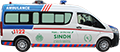
An ambulance can cross most of a city successfully and still lose the minutes that matter in its final few hundred metres. Karachi traffic is often blamed for this, but congestion alone doesn’t explain it. Blocked junctions, poor lane discipline and panicked driver reactions can close a route that heavy traffic alone would still allow an ambulance to work through.
This article breaks down what a blocked corridor actually costs against the golden hour, why drivers freeze instead of moving, what to do when you hear a siren, why lane discipline behaves differently on a road like Shahrah-e-Faisal than in a katchi abadi, and what the law in Sindh says about giving way.
The “golden hour” is the trauma-care principle that early assessment, stabilisation and treatment generally lead to better outcomes after a serious injury. It isn’t a strict 60-minute countdown for every patient. Someone with severe bleeding, cardiac arrest, breathing difficulty or stroke symptoms can deteriorate in a fraction of that time.
Set against that window, a blocked corridor is expensive. Take a simple illustration: an ambulance travelling at 30 km/h covers 400 metres in about 48 seconds. At 5 km/h, a realistic crawl through gridlocked traffic, the same distance takes close to five minutes. If a junction is fully blocked, there’s no reliable ceiling on the delay at all.
That time doesn’t come out of nowhere. It’s borrowed from the same window used for recognising the emergency, calling 1122, dispatch, patient assessment, stabilisation, transport and hospital handover. A five-minute loss in the last 400 metres isn’t a small inconvenience inside a golden-hour window. It’s a meaningful fraction of it.
Most motorists aren’t trying to block an ambulance. They freeze because a siren gives them very little time to process a decision. Mirrors don’t immediately show where the sound is coming from, motorcycles are already filling the small gaps, and buses are occupying more than one lane.
None of this is malicious. It’s what happens when drivers have no rehearsed response and have to improvise under noise and pressure.
The response that works is simple enough to remember under pressure:
1. Move left, don’t stop dead. On a multi-lane road, ease off the accelerator and move gradually toward the left where conditions allow, opening a route on the right. Where the left is physically blocked, hold your line and let the vehicles that can move create the gap. An inconsistent scatter is worse than a partial corridor.
2. Don’t brake inside the box. Do not enter a junction unless there’s room to clear it. A green light doesn’t mean the space ahead is safe; a car stopped inside the junction can block the ambulance even after the signal changes. Wait behind the line until the road ahead is genuinely open.
3. Don’t follow the ambulance through. The gap an ambulance creates isn’t a shortcut through congestion. Following it closes the corridor behind the vehicle, can block a second emergency vehicle on the same route, and puts pedestrians at risk who aren’t expecting a private car to move through that space at speed.
Beyond these three, the basics still apply: check mirrors before moving, avoid sudden braking, stay in position until the vehicle has fully passed (a response may involve more than one unit), and keep your phone down rather than filming.
Lane discipline has the most impact where there’s actually room to use it. A road like Shahrah-e-Faisal is wide and multi-laned, which means disciplined drivers staying in their lanes can reorganise toward the edges and create a genuine corridor. That advantage disappears the moment drivers straddle lane markings or stop diagonally. A road that looks wide on a map starts functioning like a narrow street.
A katchi abadi or other densely built neighborhood is a different problem entirely. Narrow streets, roadside parking, carts and encroachments can leave little physical space regardless of how disciplined drivers are. This doesn’t mean discipline matters less there. It means the available corridor is smaller to begin with, so every metre of it counts more. On a road built to carry several organised lanes, the space usually exists. Drivers just have to avoid closing it.
Yes. Under the Provincial Motor Vehicles Ordinance 1965 as amended for Sindh, obstructing the movement of an emergency vehicle and failing to yield right of way are both listed traffic offences, and reporting on later amendments has described failing to give way, obstructing an emergency vehicle, and following one too closely as separately punishable. At a 2019 seminar on those amendments, a legal representative put it plainly: anyone hindering or delaying an ambulance would be treated as violating human rights.
Fine schedules are revised periodically, and enforcement in practice depends on traffic police presence at the time. The penalty is a backstop. The corridor itself still depends on what nearby drivers do in the seconds after they hear a siren.
SIEHS 1122 is a free emergency ambulance service operating across Sindh, providing 24/7 emergency response through a fleet of 627+ ambulances stationed at 38 SIEHS stations covering all 30 districts of the province, including Karachi, Hyderabad, Sukkur, Larkana, Mirpurkhas, Tharparkar, Nawabshah and Dadu. The service is ISO 9001:2015 certified, and its ambulances carry advanced life-support systems, trained emergency medical technicians, and life-saving medication for cardiac emergencies, trauma and road accidents.
None of that equipment or training can make a physical gap appear inside locked traffic, though. Dispatch can choose the fastest available route, and trained crews can begin rapid pre-hospital care the moment they reach a patient, but the final passage through the last few hundred metres depends on what nearby drivers do.
When you dial 1122, give the call handler your exact location and a nearby landmark, a working callback number, the nature of the emergency, the patient’s condition, the safest access point, and any nearby road closure, protest, or flooding. If possible, send someone to stand at a visible point so the crew can be guided through the final streets. Once the ambulance arrives, keep its doors and working area clear rather than crowding around it.
For non-emergency medical questions, Tele-Tabeeb 1123 offers free telemedicine consultation and can help you decide whether a situation needs an ambulance at all.
The last 400 meters shouldn’t take longer than the rest of the journey. They do when drivers block junctions, move unpredictably, or follow an ambulance through the space it creates. The fix is the same three habits every time: move left rather than stopping dead, never brake inside a junction, and never use the corridor as your own shortcut.
A siren isn’t asking for road space out of convenience. It’s a warning that someone nearby needs urgent care. For a life-threatening emergency anywhere in Sindh, call SIEHS 1122. For medical advice that doesn’t need an ambulance, call Tele-Tabeeb 1123.Learn more about SIEHS’s emergency ambulance coverage across Sindh.
1. What should I actually do when an ambulance approaches in Karachi traffic?
Move left when it’s safe, avoid braking suddenly, and never enter a junction unless you can clear it. Follow any instructions from traffic police.
2. Is it illegal not to give way to an ambulance in Sindh?
Yes. Obstructing an emergency vehicle and failing to yield right of way are listed traffic offenses under the Provincial Motor Vehicles Ordinance 1965 as amended for Sindh. Fine amounts are set by Sindh Traffic Police and revised periodically.
3. What if I’m stopped at a red light and an ambulance is behind me?
Don’t jump the signal into cross-traffic. If there is space to move left, right, or forward out of the ambulance’s path without entering the junction against the light, take it. If a traffic officer waves you through, follow their direction. They are the exception.
4. What is the ambulance number in Sindh?
Dial 1122 for a free, 24/7 emergency ambulance anywhere in Sindh. For medical advice that isn’t an emergency, call Tele-Tabeeb 1123.
5. Why should I never follow an ambulance through traffic?
It closes the corridor behind the vehicle, can block a second emergency vehicle on the same route, and endangers pedestrians who aren’t expecting a private car to move through that space.
6. Does SIEHS 1122 cover my area?
SIEHS 1122 operates across all 30 districts of Sindh, including Karachi, Hyderabad, Sukkur, Larkana, Mirpurkhas, Tharparkar, Nawabshah and Dadu, through 38 stations and a fleet of 627+ ambulances.
WhatsApp us