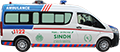
In the high-stakes world of emergency medicine, the “Golden Hour” is a well-recognised window of time. It refers to the critical period following a traumatic injury or the onset of acute illness during which prompt medical treatment has the highest likelihood of preventing death. In a province as geographically and demographically diverse as Sindh, managing this window requires more than just vehicles; it requires a sophisticated, integrated technological and clinical ecosystem.
The Sindh Integrated Emergency & Health Services (SIEHS), through its 1122 service, has revolutionised Emergency Health Services in Sindh. But what truly happens when you dial those four digits? From the initial digital handshake at the dispatch centre to the clinical intervention in the field, here is a comprehensive breakdown of the life-saving process managed by the Free Emergency Ambulance Service in Sindh – SIEHS 1122.
The journey begins at the Command & Control Centre (C&CC). Unlike traditional transport services, SIEHS operates a centralised hub that acts as the brain of the entire provincial network. Whether a caller is reporting stroke symptoms in the dense urban sprawl of Karachi or severe bleeding in the rural expanses of Tharparkar, the call is routed to a specialist Emergency Telecommunicator (ETC).
These centres are equipped with advanced Geographic Information Systems (GIS) and Computer-Aided Dispatch (CAD) software. This infrastructure allows the 1122 service to maintain a bird’s-eye view of every ambulance in the fleet, ensuring that the 24/7 emergency ambulance response is not just a promise, but a measurable logistical reality.
One of the most significant advancements in the 1122 system is the adoption of the 911 call triage model. When a caller is in a state of panic, their description of an event can be fragmented. To counter this, SIEHS utilises ProQA, a world-class software implementation of the Medical Priority Dispatch System (MPDS).
How Triage Works:
This process ensures that Rapid pre-hospital medical care is initiated even before the ambulance arrives at the scene.
The SIEHS 1122 Emergency Ambulance Service does not merely provide “pick and drop” facilities. The fleet is categorised into Basic Life Support (BLS) and Advanced Life Support (ALS) units.
An ALS unit is essentially an “ICU on wheels.” These vehicles are outfitted with advanced life-support systems, including cardiac monitors, ventilators, automated external defibrillators (AEDs), and a range of emergency medications. This allows Emergency medical technicians (EMTs) to stabilise patients suffering from heart attack symptoms or trauma injuries while in transit, significantly improving the prognosis upon arrival at the hospital.
A major challenge for healthcare in Pakistan has historically been the rural-urban divide. SIEHS has addressed this by ensuring Emergency Ambulance Coverage Across Sindh, targeting specific districts with dedicated hubs:
By decentralising the fleet, SIEHS ensures that a Free ambulance Sindh-wide is never too far from those in need.
The backbone of the service is the cadre of Emergency medical technicians (EMTs). These individuals undergo rigorous training in pre-hospital care, encompassing trauma management, paediatric emergencies, and obstetric crises. When they arrive at the scene of severe road accidents, they perform a rapid primary survey, checking the airway, breathing, and circulation (the ABCs).
Their role is to provide a preliminary diagnosis that informs the receiving hospital of what to expect. This communication is vital; it allows the hospital to prepare a trauma room or a surgical suite before the patient even clears the ambulance doors.
In a unique hybrid model, SIEHS also offers the Tele Tabeeb 1123 Telemedicine Service. This serves as a secondary layer of the 24-hour telemedicine platform. If a caller’s situation does not require an immediate physical ambulance but does require medical expertise, they are routed to Tele Tabeeb.
This integration helps manage the load on the physical ambulance fleet, ensuring that emergency vehicles remain available for life-threatening scenarios like loss of consciousness, while still providing community healthcare programs across Sindh for those requiring remote consultations.
Once the patient is secured inside the ambulance, the journey to the hospital begins. The Command & Control Centre continues to play a role here, using real-time traffic data to guide the driver through the quickest routes. In congested cities like Karachi, this navigation is the difference between life and death.
The EMTs continue to monitor vitals and administer care during the journey. For a patient experiencing a stroke, the goal is “Time is Brain.” For a heart attack patient, “Time is Muscle.” By providing medical intervention during the transport phase, the 1122 service effectively brings the hospital to the patient.
The final stage is the patient transport handover. SIEHS ambulances are integrated with major government and private tertiary care hospitals. Upon arrival, a formal clinical handover occurs. The EMT provides the hospital staff with a summary of the patient’s vitals, the treatments administered on-site, and any changes in condition during transit.
This seamless transition ensures that the chain of survival remains unbroken, providing the patient with the best possible chance of recovery.
The evolution of Sindh Integrated Emergency & Health Services (SIEHS) represents a landmark shift in public health infrastructure in Pakistan. By combining international standards like the 911 call triage system with local expertise and a massive provincial fleet, 1122 has become a symbol of hope.
Whether it is a sudden medical crisis at home or a major accident on a highway, the citizens of Sindh can rely on a rapid emergency response that is professional, free of charge, and technically advanced. Understanding the process—from the moment the dispatcher answers to the moment you reach the hospital—underscores the importance of this service as a fundamental right for every resident of the province.
WhatsApp us